Elemental Resistance: The Material Science of Waterproof Audio
Update on Jan. 7, 2026, 8 p.m.
Electronics and water have historically been mortal enemies. The fundamental physics of circuitry—relying on the precise flow of electrons along conductive pathways—is violently disrupted by the introduction of conductive fluids. For decades, personal audio was a strictly dry affair. A sudden downpour or a particularly grueling, sweat-drenched workout could spell the end for a beloved Walkman or MP3 player.
However, the modern athlete demands gear that is as resilient as they are. We have entered the era of “Ruggedized Micro-Acoustics,” where delicate drivers and processors are armored against the elements. Devices like the ZZN ZT02 Wireless Earbuds boast ratings like IPX7, promising survival in conditions that would have destroyed the electronics of just a decade ago.
But what does this rating actually mean? Is “waterproof” the same as “sweatproof”? And how does material science—from hydrophobic nano-coatings to diamond-like carbon drivers—enable high-fidelity sound in high-stress environments? To answer these questions, we must dive into the chemistry of corrosion, the physics of hydrostatic pressure, and the molecular engineering of modern materials.
Decoding Ingress Protection: The IP Scale and Hydrostatic Pressure
The badge of honor for any rugged device is its IP rating. Established by the International Electrotechnical Commission (IEC) standard 60529, “IP” stands for Ingress Protection. It is a standardized metric designed to replace vague marketing terms like “splash-proof” with quantifiable scientific data.
The rating typically consists of two numbers (e.g., IP67). The first digit refers to solid particle protection (dust), and the second refers to liquid ingress protection. The ZZN ZT02 carries an IPX7 rating. The ‘X’ indicates it has not been formally tested for dust resistance (common for audio gear where the primary concern is liquid), while the ‘7’ is the headline feature.
The Physics of IPX7
An IPX7 rating certifies that a device can withstand temporary immersion in water up to 1 meter (3.3 feet) deep for 30 minutes.
Why 1 meter? This relates to Hydrostatic Pressure. The pressure exerted by a fluid increases with depth. At 1 meter, water exerts a pressure of approximately 1.42 PSI (pounds per square inch) above atmospheric pressure. This may seem low, but for microscopic gaps in a plastic casing or the membrane of a microphone, it is significant. To achieve IPX7, engineers must design seals—gaskets, O-rings, and ultrasonic welds—that can resist this specific inward crushing force. The internal air pressure must be balanced, or the seals must be robust enough to prevent the water from breaching the perimeter.
The “Static” vs. “Dynamic” Trap
Crucially, IP testing is done in Static conditions. The device is gently lowered into still water. This is why ZZN explicitly states “(not for swimming)”. Swimming generates Dynamic Pressure. The act of a swimmer’s arm striking the water, or simply pushing off a wall, can create local pressure spikes that far exceed the static pressure of 1 meter depth. A jet of water from a shower or a forceful splash can breach an IPX7 seal that would otherwise hold in a still bucket. Understanding this distinction between static lab conditions and dynamic real-world usage is vital for device longevity.
The Chemistry of Corrosion: Why Sweat is Worse than Water
While IPX7 protects against fresh water, the most common enemy of workout headphones is sweat. And chemically speaking, sweat is a far more aggressive solvent than the distilled water used in IP testing labs.
The Electrolyte Factor
Human sweat is a complex saline solution. It contains dissolved salts (ions) like sodium (Na+), chloride (Cl-), and potassium (K+), along with lactic acid and urea. Fresh water is a poor conductor of electricity. Salt water (sweat), however, is highly conductive.
If sweat breaches the casing and touches a circuit board carrying voltage, it facilitates Electrolysis. The electric current flows through the conductive sweat between components that shouldn’t be connected, causing short circuits. More insidiously, it triggers Galvanic Corrosion. The ions in sweat accelerate the oxidation of metals (copper traces, solder joints), eating away the circuitry in a process similar to rust but occurring at warp speed due to the electrical current.
Hydrophobic Nano-Coatings
To combat this, modern engineering looks beyond mechanical seals to Surface Chemistry. Manufacturers often apply Hydrophobic Nano-Coatings to the internal components. These are microscopically thin layers (often plasma-deposited polymers) that lower the Surface Energy of the electronics.
Think of a lotus leaf. Water beads up and rolls off it because the leaf is superhydrophobic. By coating the circuit board in a similar material, engineers ensure that even if some sweat molecules penetrate the outer shell, they cannot “wet” the surface of the board. The sweat beads up and rolls off without bridging the electrical contacts. This secondary line of defense is what makes a device truly “sweatproof” rather than just “waterproof.”
The Material Science of the Driver: Diamond-Like Carbon (DLC)
Durability is not just about the casing; it is about the moving parts. The heart of any headphone is the driver diaphragm—the membrane that vibrates to create sound. In the ZZN ZT02, this component is enhanced with Diamond-Like Carbon (DLC).
Molecular Structure: sp3 vs. sp2
Carbon is a shapeshifter. Arranged one way, it is soft graphite (pencil lead); arranged another, it is the hardest material on Earth (diamond). The difference lies in the atomic bonding: graphite uses sp2 bonds (sheets), while diamond uses sp3 bonds (rigid 3D lattice).
DLC is a metastable form of amorphous carbon containing a significant fraction of sp3 bonds. It is not a diamond crystal, but a coating that imparts some of diamond’s properties—specifically, extreme hardness and lightness—to the underlying diaphragm material (usually PET plastic).
The Stiffness-to-Weight Ratio
In acoustics, the holy grail for a driver material is high Young’s Modulus (stiffness) and low mass.
1. Stiffness: A stiff cone moves as a perfect piston. It pushes air uniformly. A soft cone (like untreated paper or cheap plastic) can deform or “break up” at high frequencies, creating distortion. DLC’s rigidity ensures the driver maintains its shape even during the rapid acceleration of high-hat hits or snare cracks.
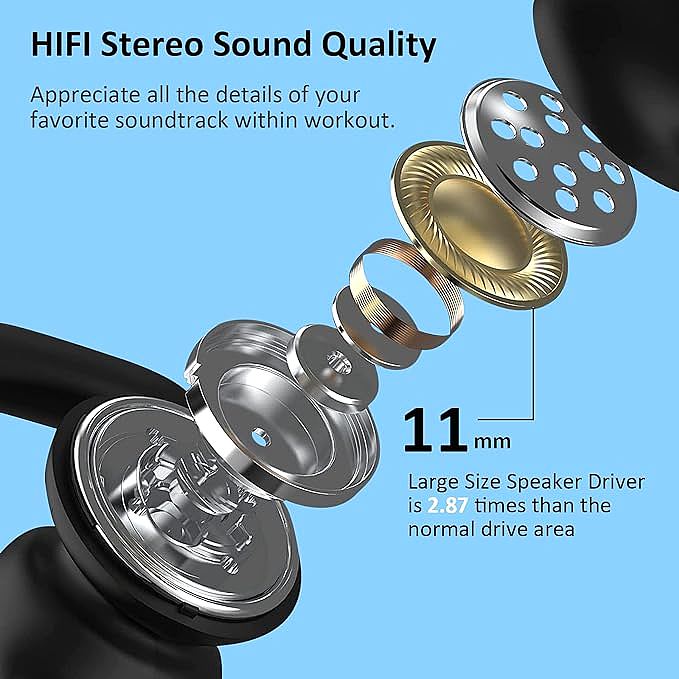
2. Transient Response: This stiffness translates directly to Transient Response—the ability of the speaker to start and stop moving instantly. In workout music, which is often driven by fast, punchy bass and sharp percussion (high BPM), transient response is critical. A “slow” driver creates muddy, booming bass. A DLC-coated driver, like the 11mm unit in the ZT02, can snap back to its resting position faster, delivering the “Punchy Bass” described in the product literature without the mud. It provides the tight, rhythmic articulation needed to keep a runner on pace.
The Connectivity Challenge in Biological Media
A final material science challenge lies not in the device, but in the user. The human body is roughly 60% water. This presents a massive hurdle for wireless audio.
RF Absorption and 2.4GHz
Bluetooth operates in the 2.4GHz ISM band. Unfortunately, the resonant frequency of the water molecule is also close to this band (which is why microwave ovens use 2.4GHz to heat water). This means the human body is an excellent absorber of Bluetooth signals.
In TWS earbuds, the signal must often travel from the “Master” bud to the “Slave” bud (or from the phone to both). If the signal path goes through the head (a sphere of water), it gets attenuated (absorbed). This is known as Cross-Body Interference.
Why Outdoors is Harder
This problem is exacerbated outdoors. Indoors, radio waves bounce off walls and ceilings (Multipath Propagation), finding their way around your head to the other earbud. Outdoors, in an open field or running track, there are no reflection points. If the direct line of sight is blocked by your body, the signal is lost.
To solve this, modern chips (like Bluetooth 5.0 and newer) use advanced algorithms and higher transmission power bursts to force the signal around the “water obstacle” of the head. The ZT02’s use of Bluetooth 5.0 is a baseline requirement for maintaining a stable connection in the signal-absorbing environment of a sweaty, moving human body.
Conclusion: Engineering for the Extremes
The creation of a reliable workout headphone is an exercise in managing hostility. The engineer must fight the ingress of water, the corrosive nature of salt, the deformation of acoustic materials, and the RF-absorbing properties of the user themselves.
Products like the ZZN ZT02 illustrate how advanced material science—from DLC driver coatings to hydrophobic sealants—has trickled down into accessible consumer technology. By understanding the physics of Hydrostatic Pressure and the chemistry of Galvanic Corrosion, users can better appreciate the capabilities and limitations of their gear. “Waterproof” is not magic; it is a calculated engineering tolerance. “Punchy bass” is not a buzzword; it is the result of high-modulus carbon structures.
As we continue to merge technology with our physical pursuits, this elemental resistance becomes the foundation of the experience. It allows us to bring the delicate art of music into the rugged arena of sport, confident that our tools can endure the sweat and the stride.